Showing posts with label community. Show all posts

Thursday, 2 July 2015

Permaculture at the Derbyshire Ecocentre Summer Fair


By Permaculture Ambassador and member Mike Hutchinson
 
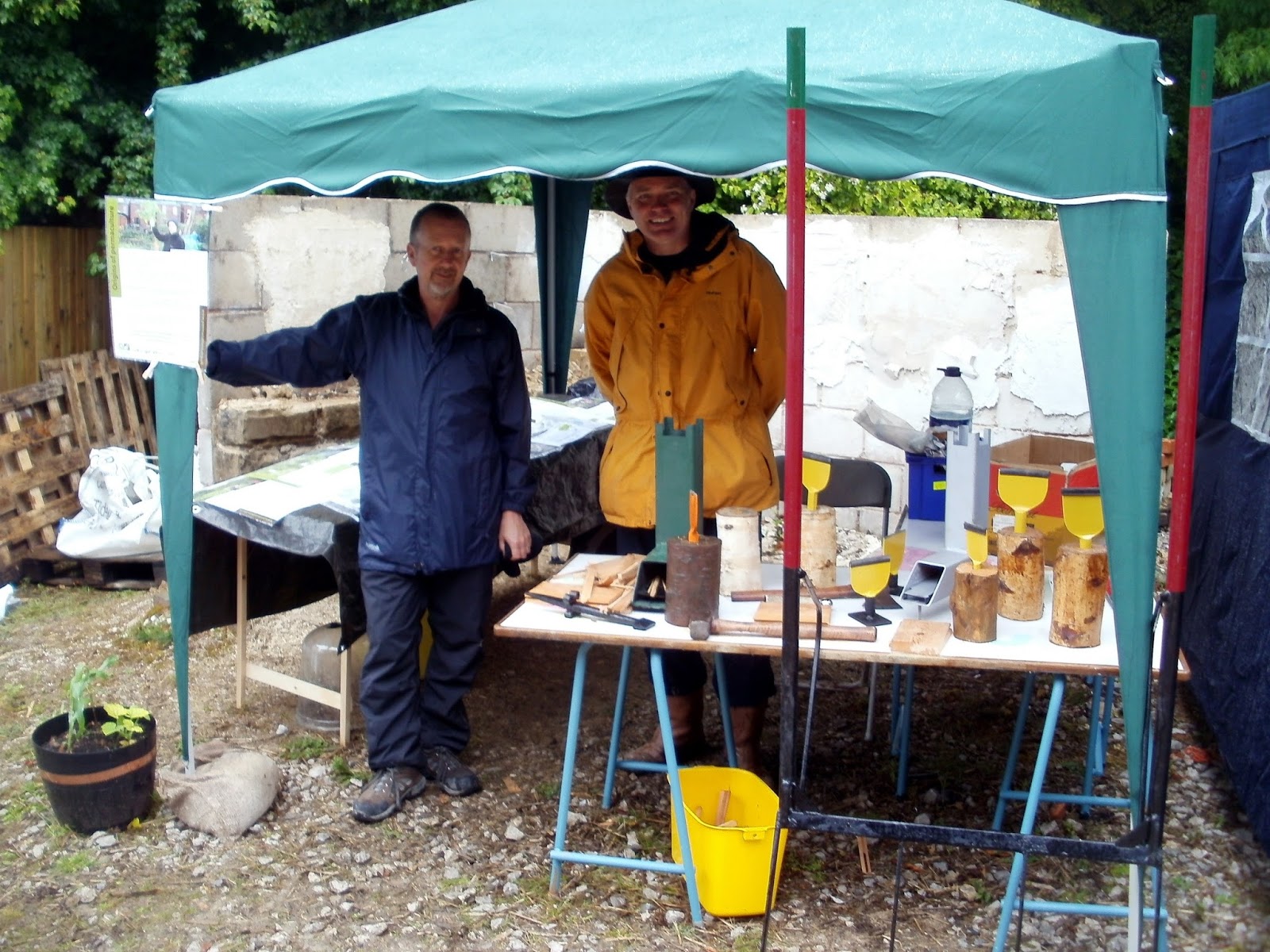
Mike Hutchinson and Matt Rawlson sharing permaculture with attendees at Derbyshire Eco Centre Summer Fair!

"There is no such thing as bad weather, only different kinds of good weather." So said John Ruskin. Although I've always suspected that Ruskin made this observation from the comfort of a warm, dry drawing room, the idea does square nicely with permaculture ideas. And on the day of the Derbyshire Ecocentre’s Summer Fair, the weather was, well ... different.

We had been allocated a plot, between a stall letting people experience dry stone walling and a young man who was a tree surgeon but who also made some really lovely products from green wood.


Once our gazebo was up and leaflets secured inside A4 plastic sleeves, we were all set up. The rain crept in around the edges but we soon forgot about it. My colleague for the day, Matt Rawlston, had made the short journey from Mansfield with a selection of tools he’d made, using old and discarded items. These included his magnificent ‘cargo’ bike; a long-wheelbase version with a flat wooden platform at the rear and a range of 'safety' axes.


Use and value renewable resources and services: new tools from old

Matt's collection of items, many finished in a bright yellow, drew people to the stand. The safety axes in particular, intrigued people and following quick demonstrations all agreed that they were a very good idea. (The axes are made by reducing the length of old bolsters, then sharpening the blade. The handle fits into a ready-made hole in a log. Chopping is essentially reversed, with wood placed onto the blade then tapped down with a hammer, thus keeping fingers nicely out of the way.)

Matt talks to attendees about his safety axes.
Describing how these once discarded tools had been given a new lease of life then led easily into a discussion of permaculture in a broader sense. Some visitors had heard of permaculture; others hadn't. Whatever the level of knowledge, we had some interesting conversations ranging from the ethical principles via no-till gardening, composting and soil structure to forest gardens.

Display with cargo bike, safety axes, three sisters pot and broadfork.
Although still in their early stages of growth, the trio of plants I'd taken along in a pot - corn, beans and squash - let us illustrate how applying permaculture design means we can get so much more out of the individual elements. Perhaps the 'three sisters' combination doesn't always work out as well in Britain as in the Americas, but it makes an interesting talking point. People really do get the idea of how permaculture design gives you increased resilience.

Example of the very fuel efficient jet stove.
The other aspect of my 'three sisters' was that they were in a 'wicking' pot. Okay, this wasn’t the best of days to show a pot that has a built in reservoir but the idea was easy to get across - and given the rainfall, I could demonstrate the drainage holes easily.

Matt had also brought two jet stoves with him that he'd made from recycled steel fence posts. Given the weather it would have been great to have had one lit, but for safety reasons this obviously wasn't possible. People were genuinely interested in the stoves and we were able to discuss their benefits, including how the spread of efficient rocket stoves in the Global South can improve people's health.

After the samba band stopped and the last visitors had left we took the gazebo down and packed everything away. Overall, it had been a good day, which seemed to pass quite quickly - always a good sign, I think. And despite the rain, which was now falling harder again, and despite its obvious effect on visitor numbers, we agreed that it had been successful.


A decent number of people had stopped to look at the stand and we'd been able to talk about permaculture. And had John Ruskin visited the Ecocentre on Saturday, I think he would have definitely stopped at the permaculture stand - whatever the weather.

Share the benefits of permaculture

If you, like Matt and Mike, would like to share the benefits of permaculture with your local community, find out how you can get involved here.

There are many ways of helping to spread the word about permaculture, whether it be by giving a gift membership to a friend, signing up to hear about opportunities via 'Ambassador Alerts', starting a local permaculture group, or writing a blog post about how you apply permaculture to your everyday life. We'd love to hear from you, so get in touch!

Tuesday, 16 June 2015

The history of the Permaculture Zone at Green Gathering - and what's in store this year!


By Permaculture Association member and Permaculture Zone Coordinator Tammi Dallaston


Green Gathering's Permaculture Zone - a place to learn, get involved, and meet new friends!

From its roots at Lower Pertwood Farm in the late 1990s, the permaculture area at the Green Gathering (formerly Big Green Gathering) has always sought out and linked permaculture practitioners in the UK and beyond.


Our original gardens were designed by Patrick Whitefield, Ken Fern (Plants for a Future), Helen and Jim Morris-Ridout (Copper Beech designs), and Tammi Dallaston (Made in Mach), and tended by many many volunteers over the years. Since the festival moved to Somerset, and latterly Chepstow, the permaculture area has relied on temporary displays, engaging speakers and a diversity of practical workshops.


At our new home in Chepstow, the permaculture area is billed as a temporary intentional community. We eat together, organise our days together, freely ask for and offer help, and showcase an inclusive way of life that can be possible with the three permaculture tenets: earth care, people care and fair shares.

This year the Permaculture Area will incorporate a Green Parenting space, Forest School, Willing Workers On Organic Farms (WWOOF) stall, Permaculture Association and International Permaculture Convergence info, Patrick Whitefield Memorial, Organic Tannery, free Seed Swap, wood-powered thermo-electric and solar phone charging, and a fireside space for conversation, singing and plotting…

PLUS workshops, to include:
Introduction to Permaculture: by Mike Feingold; meet him on youtube

Ecovillage Living: a daily workshop discussing ecovillage living, Welsh planning law, designing your dream home/community, and life in the Lammas ecovillage, by Tao and Hoppi Wimbush

Growing for Preserving: see permacultureplate.blogspot.co.uk

Dynamic Woodland Management: using Permaculture Principles, with Stephen Watts

Not yet a member? Join today!

Tuesday, 2 June 2015

Permaculture Day 2015: In Support of Soil Report - call for more contributions!


By Nicola Bell, Membership Coordinator


A huge thank you to those of you who helped more people to hear about the benefits of permaculture on International Permaculture Day! 

You were part of 200 events and actions in 43 countries - thank you for making them happen!

Please help the International Permaculture Day 2015 team to compile photos, videos and stories for the International Permaculture Day 2015: In Soil Supporters Report - click here to contribute.

Some Permaculture Association members have already shared their successes with the network:


Abundant Earth, Co Durham:
It may have been freezing cold but around 70 of you came to the Abundant Earth open day today....Thanks for your effort and your company! 
The day coincided with International Permaculture Day. This year the focus was on soil and Wilf gave tours and talks throughout the day relating to this topic. 
Children ate fairy cakes and bounced on the trampoline, some of them bottle fed the lambs and planted flowers. 
Mark and Vicky brought their biochar demonstration which was incredibly informative and lots of people now have a biochar sample. 

Matt giving a wood turning demo at Abundant Earth
Matt made a beautiful bowl on his pole lathe for all see. Beth tried to weave on the peg loom but it was a bit chilly! 
Lashings of hot tea was freely available and tasty cakes were for sale; a percentage of which we will send to the Kathmandu Earthquake fund.
Mike and Vicky demonstrating bio char at Abundant Earth
We also sold our eggs, salad and some of west ridings organic compost.
There were a great deal of leaflets and books to browse and there was a dvd playing about permaculture and soil.
Our next open day is on Sunday September 6th! Save the date!!!

Pennerley Permaculture Project, Shropshire:
We had 14 people come for a two hour tour of the plots and forest garden followed by tea, cake and discussion. A good time was had by all. One person e-mailed after to say, "We just wanted to drop you a brief note to say a real big thanks for your time and insights on Sunday – packed full of gems and golden nuggets and very much appreciated."

Glengall Wharf Garden & Burgess Park Food Project, Peckham:
Worries about the weather disappeared almost as soon as we came on site – the afternoon was fresh and glorious. A great turn out of people, lured by the promise of learning more about soil and how to manage it meant we got lots done and ate well. Read more on the blog...
Searching for frogs at Glengall Wharf, Peckham

The Grange, Norfolk

Over three days we stock fenced over 200 metres of meadow, built a new plinth base for the yurt, potted on at least 100 courgette and squash plants, built a rocket stove, weeded the herb garden and cut and split over a tonne of wood. But it wasn’t all work…on Sunday night we fired up the cob oven and cooked some delicious pizzas before watching a film on the projector and each day was punctuated by wonderful food and conversations.

After three tiring but exhilarating days our project here seems possible again, at least for a little while. But it won’t be long before another blitz is needed – and we will put out the call for help once more!
Tom and Ben putting the finishing touches to some stock fencing at The Grange
Ian making pizza for dinner at The Grange


I did a workshop on Edible Landscapes at the local "Spring Greens" Festival, with about 20 people. The festival's theme was "the land" and it  also had presentations by Chris and Looby on their new Applewood project, by Simon Fairlie on land rights, a permaculture stall by Roz Brown as well as many other stalls and events. 700 people attended - great success!
The Beautiful Spring Greens Fair 2015


Mike Pope, Lancashire
The course went really well, lots of positive feed-back, (thank you for the material you sent). Two of the participants came as a result of seeing it on the Permaculture Association website. 
We covered the meaning and ethics of Permaculture in the morning, ending with a presentation of an eco-renovation of a terraced house from our friend Andy Hunt.
The afternoon was a discussion and videos of the principle of forest gardening, followed by a trip to our forest garden (hopefully soon to be a Land Centre). On the Sunday we had a volunteer session at the garden which was well attended. We hope to run another similar event in the autumn. 

Offshoots Permaculture Project, Lancashire
Victoria Woods and Phill Dewhurst spoke at the Alternatiba event in Todmorden on Sunday 3rd May.

The talk was well attended with over 40 people and standing room only at the venue, Todmorden Town Hall

The presentation was an introduction to Permaculture with a focus on soils and positive solutions and Offshoots Permaculture Project
For about 45 minutes we gave out information and answered questions, showed a short 6 minute film of Offshoots as well as publicised the next local Permaculture Design course starting Saturday 6th June 2015

If you'd like to learn more about permaculture demonstration sites like these, or to find one near you, check out the LAND network.

Please help the International Permaculture Day organisers by sharing your stories and photos, so that we can celebrate everyone's involvement! 

We also have also set up a Flickr album to share activities that happened across the network, so feel free to send more to us at the Permaculture Association.

If you would like to host a talk, course, festival, tea party, seed swap or anything else for International Permaculture Day 2016, please let us know!


Friday, 1 May 2015

Nurturing Your Local Permaculture Network - more...


by Nicola Bell, Membership Coordinator

Welcome to the second in a series of posts aimed at giving support and ideas to help new local permaculture networks to germinate. For the first, click here!
Get more done, working together!

What sort of group are you?

Permaculture groups vary widely in size and activities across the UK. If you're just starting out as a new permaculture group, it's worth looking at other successful groups across the network, to get an idea of what you could potentially achieve together, or how you would like to evolve. 

Here are some examples from different regions:


Please let us know more about your group if you would like to be featured here or in future features. Many of these groups have Group Permaculture Association membership, and benefit from listings in the newsletter 'Permaculture Works' - click here to join as a group member.

Activities to do as a group

It is sometimes daunting to coordinate a series of events if you're just getting started. Take it easy, why not get to know one another first, and see how things evolve! Here's Lausanne of the fantastic new Hull Permaculture group:

"We first thought about forming our Hull Permaculture group after our permaculture design course had come to an end. It was formed as a means for us to keep in touch and continue learning together.
We try to meet up on a monthly basis. During the winter months we usually meet up at a local pub, have a chat, bring books, magazines and questions to share, and have group discussions.
When summer comes around we take advantage of the lighter nights and visit each others sites, projects and allotments.
One of our members, Janet, works for the NHS and has an allotment space set up to nurture positive mental health and well-being, and this has been very inspiring.
We will also organise socials and meals at each other's houses, and one of our members has recently started running a permaculture picturehouse from an outhouse in his garden!
We are planning visits to other local group events they year, such as Leeds Permaculture Network, and we also hope to visit some LAND Centres.
- Lausanne Tranter, Hull Permaculture Group and Permaculture Association member


Hull Permaculture
Hull Permaculture members: Lausanne Tranter, Tracey Henry and Ashley Forrester at the Constable Street field. Photo: Simon Renilson

Some other ideas for activities include:

  • Organise a permaculture film evening - you can now watch 'INHABIT - the permaculture perspective' online!
  • Host a seed swap
  • Organise a skill swap
  • Invite a guest speaker to come and talk to you
  • Hold a permaculture coffee morning
  • More examples coming up in the next post!
Are you part of a regional group? Please let us know what you get up to, so we can share with the network.

Engagement and gaining new members

As I mentioned in the previous post, twitter, facebook and mailing lists are a great way to encourage others to engage with your activities. Having a Flickr page to share your achievements together is another option - just check out these great active Flickr sites made by Permaculture Association members and tell me you're not inspired!
You could also consider getting a website or blog to bring all of this together, including a calendar of upcoming work days and socials. 'Wordpress', 'Drupal' and 'Joomla!' are all free and user friendly content management platforms that allow you to create beautiful websites.
Permaculture Association members can also add their courses and events listings online, as well as jobs and opportunities. These are promoted via our monthly ebulletin which goes out to over 7,000 subscribers, so it's well worth it. Find out how to join here.

It is as important, if not more, to get the word out offline. There are those of us who do not have access to the internet, and those who are always out and about and you're more likely to engage away from a screen - you want to make sure everyone gets the invite to learn about permaculture, and benefit from being actively involved in their community. Here are some ideas of locations you could approach to help promote your activities with simple posters (remember to get permission first!):

  • Allotment noticeboard
  • Library
  • Community Centre
  • Health Food Shops
  • Cafes
  • Universities and schools
  • Community Centre
  • GP surgery
  • Places of worship
  • Yoga Centre

If your group chooses to become a Group member of the Permaculture Association, you'll benefit from a listing in 'Permaculture Works', which helps new members near you to find you.

You should also spread the word to other regional networks who share your ethos; it's all about working together to bring about positive change after all! Here are some ideas of organisations who may have regional groups in your area:

Need a venue?

If you're the sort of group that's going to out grow your local cafe or pub as a meet up space, you might want to start looking for a venue to hold monthly socials. A lot of the establishments listed above may also have meeting rooms and break out spaces that you could potentially hire for an evening, so it's worth enquiring. 
Permablitz in action!

You may also find that some venues would welcome the addition of a permaculture design. For example, Cecil Sharpe House in London, which hosts the annual London Permaculture Festival, won an award after permablitzlondon transformed the entrance into an edible and wildlife haven!

If you've got a good idea for a possible permaculture group venue space, let us know here.
Once you've put the word out about the exciting events and activities you've got planned, enjoy connecting and enhancing your community with permaculture! :)


Please help more regional permaculture groups succeed

We are facilitating the creation of an FAQ with help from our experienced permaculture groups across the network! If this is you, we want to hear from you! Please share your experiences of setting up and running up a group, so that more can succeed.


Next time: More great activities to do as a group, and some social media tips - permaculture style!

Become a Group Member of the Permaculture Association and get your group listed in Permaculture Works here!

Monday, 30 March 2015

Nurturing your local permaculture network


by Nicola Bell, Membership Coordinator, The Permaculture Association

Eastern Region Network designing a mandala garden

Welcome to the first of a series of posts of tips and advice for setting up and growing a local permaculture group. We want to make sure that you are able to connect with permaculture happening where you are, and that your community can benefit from the practical solutions it offers.

We aim to develop and FAQ to support emerging groups based on advice given by existing local networks, so if you have an established group, please contribute your experiences and knowledge here!

Why form a local permaculture group?

Permaculture is all about learning how to design homes, communities, businesses and food-systems that promote fairness, well-being, ecosystem health and that have little impact on our planet and it's resources.

Creating a permaculture network helps to disseminate knowledge and skills relevant to your region, and also provides a way to pool resources together and implement positive changes within your community.

Being a part of the permaculture network has helped me to understand the tools that are available a lot more - individuals cannot usually change the world on their own, but communities can, by sharing knowledge, skills, time, understanding and support. I would not have contemplated doing the diploma without the support of my fellow permies. - Ann Laken, Permaculture Association member and Diploma Holder

Permaculture networks and groups come in many different sizes and shapes, and their activities and profile vary widely. Some meet up chiefly to share knowledge and support each with their projects and progress on the Diploma in Applied Permaculture Design, others coordinate local permablitz days, and some won't meet face to face, but use social media to support each other and communicate their regional permaculture news. All are important and strengthen permaculture work in the UK.


First Steps

As a first step, it's helpful to know if there is an existing local network near you, or if not, who is in the area that might like to start one. Permaculture Association members can contact the office to connect with other members in their locality, so if you'd like to know who's close by, just drop me an email. We also list Group Members within our members newsletter, which is another great way to find out what's happening in your region. Click here if you'd like to join and receive 'Permaculture Works'.

You may also find that there is a permaculture demonstration site, or LAND Centre, nearby. Take a look at the LAND map to see which is closest to you. It is worth getting in contact to see if you can visit your nearest sites; it's a really inspiring way to engage with local permaculture.

Children in the orchard - The Apricot Centre, Essex
“The Apricot centre is listed as a LAND centre in Essex and will be also listed in Devon once the new farm project starts at Huxhams cross Farm near Totnes. This network of farms and holdings, buildings and people builds communities, People often tell me how they feel isolated from other like minded people, especially in areas such as Essex where we are spread thinly on the ground! The LAND network gives people the opportunity to see what is going on in any area, give you a call and visit, they often then give me news from other sites and places they have visited. Sometimes they come back and volunteer or sign up for a course. " - Marina O'Connell of The Apricot Centre, Essex
Apple harvest school project - The Apricot Centre, Essex

If you find that a distinct hub of permaculture activity doesn't seem to have developed near you yet, don't be disheartened - this is a great opportunity to start something special! We want to help you make it happen.

We can help you circulate your ideas about starting a permaculture group to local members. Once you've reached a consensus about forming a group, try and come up with a name which represents your region, or bio-region. Let us know, so that we can signpost others to you.

Mailing groups, twitter, forums and facebook are all useful/free ways to stay in contact with your group members, engage more and keeping momentum going. Think about setting one or two of these up to keep everyone in the loop while you think about the exciting ways you can work together to enhance your community with permaculture!


Next time – What sort of group are you? More ways to promoting your group, finding a venue, and some activities to get started!

Did you like this post? Please share :)

Friday, 30 January 2015

Get ready to celebrate International Permaculture Day 2015!


International Permaculture Day takes place on May 3rd this year, and plans are already underway to celebrate in a variety of exciting ways!

Edible Landscapes London, just one of many fantastic projects within our network of permaculture demonstration sites, regularly host an annual plant give away to celebrate the event. This year's plant give away takes place on May 4th.


Edible plants at Edible Landscapes London
Edible Landscapes London is a volunteer-led project which aims to help Londoners grow more of their own food. They propagate edible plants which are then used on local growing projects. They also teach people how to recognise plants, identify which parts of the plant are edible, how to propagate them, how they are grown in a forest garden, and even how to cook with them.


Because we're based in a busy London park, we're very used to having people wander in to visit our project. International Permaculture Day is a great way of explicitly bringing the permaculture elements to the surface.
This year we're celebrating by showing people around our site and letting them leave with a few perennial plants for their community food growing project. - Jo Homan of Edible Landscapes London

A plant give away is a fantastic way to celebrate International Permaculture Day, as it gives people the opportunity to come together and meet like minded people, learn something new about permaculture and keep it in mind as they watch their new plant thrive throughout the year.

There are many other simple ways to celebrate throughout May. Why not host a permaculture coffee morning, share one of your permaculture designs with a local group, or invite friends to a permaculture meal?

This year Permaculture Association members can add their events and courses to www.permaculture.org.uk in association with International Permaculture Day - we will promote these to contacts in your area.

Be sure to had your events to International Permaculture Day website so that the Uk is well represented during this global celebration of permaculture!

Tuesday, 6 January 2015

Habiba Community – building sustainability and community resilience in South Sinai

by Alice Gray


Workshop for local farmers with technicians from the Ministry of Agriculture, November 2014. Photo by Habiba Community. 

Nestled between the rugged Sinai Mountains and the gently lapping waters of the Red Sea in Nuweiba, a small port town in southern Sinai, lies Habiba Community: a pioneering organic farm, a community agriculture initiative, a learning centre and a beach lodge.

The vision of Habiba is to support the Sinai community in creating a secure and abundant future for themselves, transitioning away from dependency on tourism and government handouts. Maged El Said and his wife Lorena started the project in 2007, motivated by their love for the community that had become their home over the past 20 years. 

Nuweiba village is in South Sinai, an area traditionally populated by Bedouin tribes, which saw rapid development as a tourist destination during the latter half of the 20th century, as the beguiling beauty of the Red Sea’s pristine coral reefs combined with the austere splendor of the Sinai peninsular’s granite and sandstone mountains was recognized.

Unfortunately, all too often, this development took no account of either the environment or the local communities, and much damage has been done to both. In Sharm el Sheikh, the most popular resort in the region, there is barely a single Bedouin owned business and the local community has been almost completely disenfranchised from the lucrative tourist industry that has sprung up. Hotels with swimming pools and lawns guzzle scarce water resources and pollute the environment with their wastes. Many tourists travel to Sharm el Sheikh on all-inclusive ‘package deals’, some barely leaving their hotels and many not venturing outside the town. Today, over 45% of Sinai’s Bedouin community live in poverty according to the Social Fund for Development’s 2013 Poverty Map (read report here: http://www.al-monitor.com/pulse/originals/2014/04/sinai-egypt-residents-anger-empty-government-promises.html). 

In Dahab and Nuweiba, on the south-eastern coast, the story was a little different, as development was more often done in cooperation with the Bedouin communities. The resorts that grew up had a very different feel to them, with sea-side beach lodges constructed of local materials, and sometimes with Bedouin owners, offering rustic accommodation and Bedouin guides offering safaris and camel treks into the interior. Maged (originally from Cairo) founded Habiba Beach Lodge in 1994, and for many years ran a successful business in cooperation with his neighbours. Today, however, tourism is in decline, due to growing political instability in the region, and cannot be exclusively relied on to provide livelihoods. Due to the heavy investment of Egyptian businessmen in Sharm el Sheikh, this area is protected inside a security cordon maintained by the Egyptian army, but this protection does not extend to resorts further north, like Nuweiba. 

Hence, Habiba Community was born, in an effort to diversify income and create food security through pioneering and promoting sustainable, organic agriculture. First, Maged bought land and set up Habiba Organic Farm, to pioneer successful techniques for desert farming and experiment with novel crops. 


Moringa oleifera trees at Habiba Farm, November 2014. Photo by Alice Gray.

The farm is a mixed orchard and vegetable production system, with poultry and other small livestock. Maged was the first farmer in Sinai to grow Moringa oleifera, sometimes known as the ‘miracle tree’ – a fast growing, nitrogen-fixing, drought tolerant tree with a multiplicity of uses. The leaves are edible and are a ‘superfood’ with enormous nutritional benefits: containing more Vitamin C than oranges and more iron than spinach (find out more here: http://miracletrees.org/). The seeds are high in nutritious oil and are also edible, or can be used as a flocculant for purifying water. Maged has had enormous success with this crop and is experimenting with inter-planting it with Date Palms – a signature crop of the Sinai.

Maged has worked hard to share his ideas and successes with others, inviting experts to give workshops for aspiring farmers free of charge, supporting several new farmers to start up their businesses, distributing seeds and equipment and building a network for marketing organic produce. Every week, he attends the Dahab Community Market, holding a stall all day to sell produce and raise awareness of Habiba and its work. 

Maged El Said managing his store at Dahab Community Market, February 2014. Photo by Alice Gray.

He also started the Sinai Date Palm Foundation as a way for community members to buy in without having to buy land or start their own farms. This innovative but simple strategy is to sell ‘shares’ in a date growing business, where high quality Medjool date palms are grown and maintained by the Habiba Farm team, and processed and sold by the Date Palm Foundation. By buying a share, a community member becomes the owner of one tree and receives 80% of the profit from the sale of the raw product (20% is taken to cover the costs of running the farm). The Foundation undertakes to buy all the dates from the farm and process and market them, providing jobs for local people. Profits are used to expand the business, and buy more equipment or more land (or you could say, surpluses are returned to the system). 

Never content to rest on their laurels, Habiba have recently started a brand new Learning Centre to help educate the children of Nuweiba and equip them with the skills they need to face an uncertain future. Education in the Sinai is generally poorly funded and somewhat ineffectual as the Sinai Bedouin remain one of the most marginalised sectors of Egyptian society. Lorena Al Said is leading an initiative to support the education of local children, teaching English, Arabic, Music, Art and of course, farming skills in an after school club, open 5 days per week. The Learning Centre has proved enormously popular and now has around 40 regular participants. 


Lorena Al Said working with Nuweiba children at Habiba Learning Centre. Photo by Habiba Community.

Indeed, the program is so popular that new facilities need to be built so that it can continue to grow and prosper. In cooperation with ECOntACT (www.econtact.be), an Italian group promoting all forms of reuse and exchange, Habiba Community will construct a strawbale building to serve as a classroom and laboratory. Funding is being generated through the participation of paying volunteers and through the sale of arts and crafts made by the children in the after school club, at Dahab community market. The build is set to take place from January 1-7 2015, and there is still time to sign up if you would like to support a worthwhile project while soaking up some winter sun (go to www.econtact.be to find out more)!

In the seven years it has been in operation, Habiba Community has gone from strength to strength. Although Maged is not a PDC holder, and did not set out to create a permaculture project per se, the principles of permaculture are evident in a lot of what he has done; and furthermore, his goal of achieving a sustainable and resilient community is the essence of what permaculture is about. The success of the farm speaks for itself, and the farm manager (Tha’er) is a superbly skilled technician, with a lot to teach about arid zones farming. They have a growing awareness of permaculture design as a strategy that could be of real benefit to the community and are eager to learn more, to apply design principles to existing projects, to innovate and experiment, and to host courses: building local capacity as well as gaining international attention and financial support for their work.

Habiba is open to receiving volunteers all year round, and it is a wonderful place to relax, let the sound of the sea fill your ears and the quiet, green growing energy of their desert farm transport you to a vision for a sustainable and abundant future. 


Maged Al Said (left) with farmer Abu Rami (2nd from right) at a desert farm that Habiba Community helped establish between Nuweiba and Dahab

Find out more and keep updated at www.habibaorganicfarm.com

Contact Maged on nuweiba@gmail.com