Showing posts with label Network. Show all posts

Wednesday, 26 August 2015

The Green Gathering

By Phil Moore of Permaculture People


A festival is a funny thing. A celebration, an escape, an alternative, a way of life. Many things rolled up into a musically charged programme of fun, frolics and serious chats. Often in a field. 


What struck me about the Green Gathering was its commitment. Appropriately billed as a 'gathering', and free from the dictates of advertising, the Green Gathering felt like a genuine attempt at saying, "Oi! Another world is possible and look-y right here!". A world where we think about where our shit goes (check their Indiegogo compost loo crowdfunder), where we can say no to things as well create spaces where differences in opinion can be heard respectfully; where consumerism isn't the barometer of modern living, and where the exchange of ideas, foods, crafts and skills are celebrated and shared.
Windmills and blue skies
Occupying a temporary space next to Chepstow raceourse with the shell of the 18th century Piercefield House lurching from one side and views toward Severn Bridge and into the folds of the green Wye Valley at the other, the Green Gathering is set at a striking location. 


Composed of different 'Zones' we were crewing at the Permaculture Zone which was to be our home for the next five days. We managed the info stall tent letting people know what was going on. The vivacious Mike Feingold held introductions to Permaculture, author and permaculture teacher Caroline Aitken shared her knowledge & passion for food preservation; Biochar Ed spoke of the wonders of pyrolysis, beekeeping introduction, chickens, composting, a solar power workshop and so much more took place. It was also a great chance to meet many faces - new and old.

A mini-festival within a festival the energy and diversity of the workshops was testament to the giddying array of what the Green Gathering had to offer.

Seed bomb making workshop
Recycling solar power windmill
Mike Feingold and paint
Caroline Aitken workshops
In the wider reaches of the fields music bounced and echoed around the hillside depressions that formed natural amphitheatres. The greats Seize the Day and Martha Tilston played alongside newcomers and regulars.

Walking from the Tipi Circle to the Healing Field through to the Faerie Glade and on to the campaign area, the ease with which different ideas sat side by side made for a refreshingly relaxed yet stimulating festival that was also child friendly.

All the energy and drama poured into a specific place for a set amount of time resulted in a beautiful world of music, muck & magic, politics, fancy dress and blowing bubbles where all hues of humans and tastes gathered and jiggled their wants and wares. 


Powered by the Sun yet motivated by people the Green Gathering isn't just an event. It's an idea. A long standing festival in the peculiarly British tradition of celebrating stuff in a field, the Green Gathering has a rich, and tumultuous, history. Such gatherings are fantastic opportunities to delve deeper in the ideas and practical workings of how to lead a low-impact lifestyle with having fun at the same time. I would heartily recommend it as a place to feed your soul and colour your imagination.


For more about the Green Gathering: http://www.greengathering.org.uk

Thursday, 2 July 2015

Permaculture at the Derbyshire Ecocentre Summer Fair


By Permaculture Ambassador and member Mike Hutchinson
 
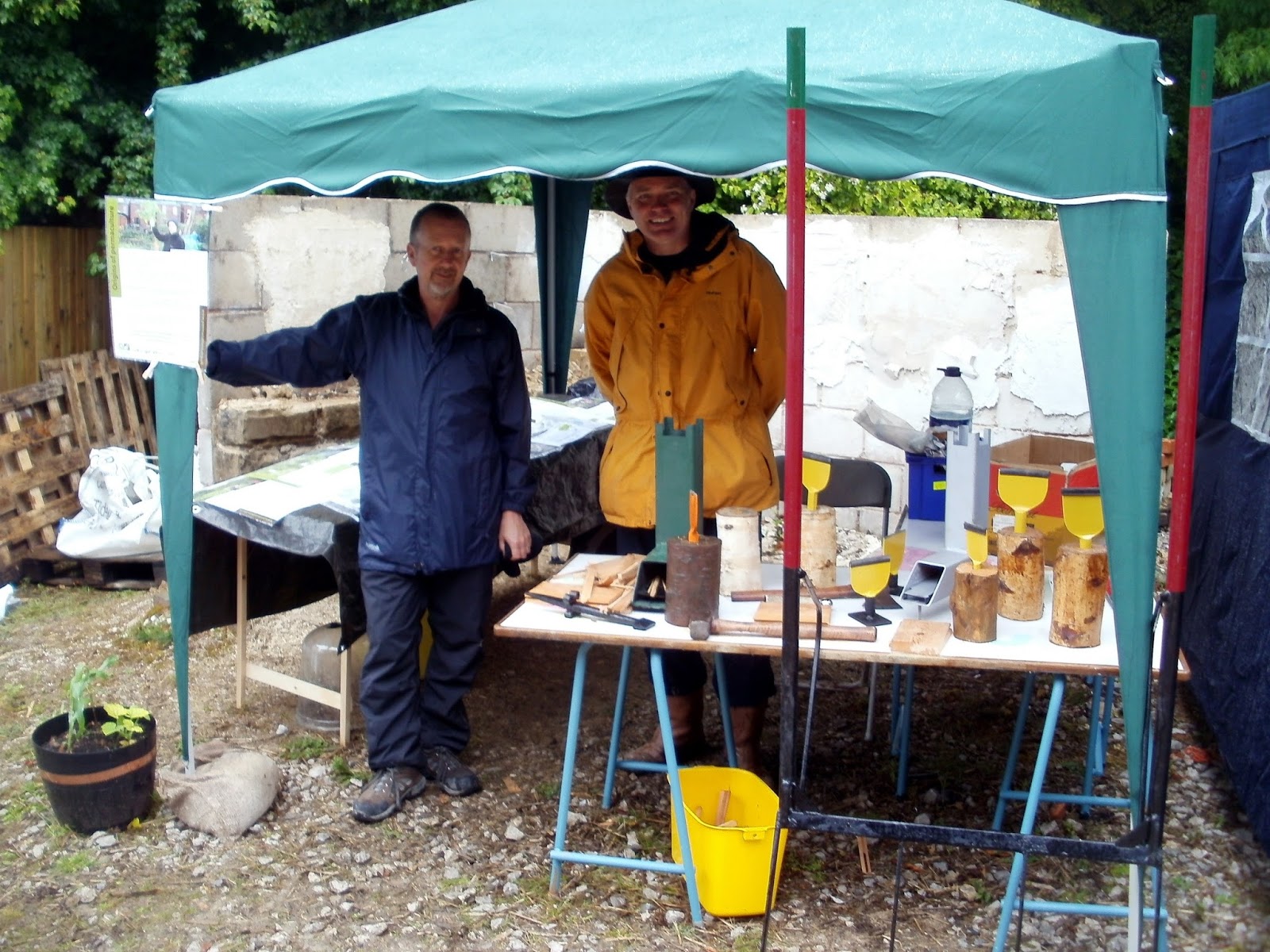
Mike Hutchinson and Matt Rawlson sharing permaculture with attendees at Derbyshire Eco Centre Summer Fair!

"There is no such thing as bad weather, only different kinds of good weather." So said John Ruskin. Although I've always suspected that Ruskin made this observation from the comfort of a warm, dry drawing room, the idea does square nicely with permaculture ideas. And on the day of the Derbyshire Ecocentre’s Summer Fair, the weather was, well ... different.

We had been allocated a plot, between a stall letting people experience dry stone walling and a young man who was a tree surgeon but who also made some really lovely products from green wood.


Once our gazebo was up and leaflets secured inside A4 plastic sleeves, we were all set up. The rain crept in around the edges but we soon forgot about it. My colleague for the day, Matt Rawlston, had made the short journey from Mansfield with a selection of tools he’d made, using old and discarded items. These included his magnificent ‘cargo’ bike; a long-wheelbase version with a flat wooden platform at the rear and a range of 'safety' axes.


Use and value renewable resources and services: new tools from old

Matt's collection of items, many finished in a bright yellow, drew people to the stand. The safety axes in particular, intrigued people and following quick demonstrations all agreed that they were a very good idea. (The axes are made by reducing the length of old bolsters, then sharpening the blade. The handle fits into a ready-made hole in a log. Chopping is essentially reversed, with wood placed onto the blade then tapped down with a hammer, thus keeping fingers nicely out of the way.)

Matt talks to attendees about his safety axes.
Describing how these once discarded tools had been given a new lease of life then led easily into a discussion of permaculture in a broader sense. Some visitors had heard of permaculture; others hadn't. Whatever the level of knowledge, we had some interesting conversations ranging from the ethical principles via no-till gardening, composting and soil structure to forest gardens.

Display with cargo bike, safety axes, three sisters pot and broadfork.
Although still in their early stages of growth, the trio of plants I'd taken along in a pot - corn, beans and squash - let us illustrate how applying permaculture design means we can get so much more out of the individual elements. Perhaps the 'three sisters' combination doesn't always work out as well in Britain as in the Americas, but it makes an interesting talking point. People really do get the idea of how permaculture design gives you increased resilience.

Example of the very fuel efficient jet stove.
The other aspect of my 'three sisters' was that they were in a 'wicking' pot. Okay, this wasn’t the best of days to show a pot that has a built in reservoir but the idea was easy to get across - and given the rainfall, I could demonstrate the drainage holes easily.

Matt had also brought two jet stoves with him that he'd made from recycled steel fence posts. Given the weather it would have been great to have had one lit, but for safety reasons this obviously wasn't possible. People were genuinely interested in the stoves and we were able to discuss their benefits, including how the spread of efficient rocket stoves in the Global South can improve people's health.

After the samba band stopped and the last visitors had left we took the gazebo down and packed everything away. Overall, it had been a good day, which seemed to pass quite quickly - always a good sign, I think. And despite the rain, which was now falling harder again, and despite its obvious effect on visitor numbers, we agreed that it had been successful.


A decent number of people had stopped to look at the stand and we'd been able to talk about permaculture. And had John Ruskin visited the Ecocentre on Saturday, I think he would have definitely stopped at the permaculture stand - whatever the weather.

Share the benefits of permaculture

If you, like Matt and Mike, would like to share the benefits of permaculture with your local community, find out how you can get involved here.

There are many ways of helping to spread the word about permaculture, whether it be by giving a gift membership to a friend, signing up to hear about opportunities via 'Ambassador Alerts', starting a local permaculture group, or writing a blog post about how you apply permaculture to your everyday life. We'd love to hear from you, so get in touch!

Friday, 1 May 2015

Nurturing Your Local Permaculture Network - more...


by Nicola Bell, Membership Coordinator

Welcome to the second in a series of posts aimed at giving support and ideas to help new local permaculture networks to germinate. For the first, click here!
Get more done, working together!

What sort of group are you?

Permaculture groups vary widely in size and activities across the UK. If you're just starting out as a new permaculture group, it's worth looking at other successful groups across the network, to get an idea of what you could potentially achieve together, or how you would like to evolve. 

Here are some examples from different regions:


Please let us know more about your group if you would like to be featured here or in future features. Many of these groups have Group Permaculture Association membership, and benefit from listings in the newsletter 'Permaculture Works' - click here to join as a group member.

Activities to do as a group

It is sometimes daunting to coordinate a series of events if you're just getting started. Take it easy, why not get to know one another first, and see how things evolve! Here's Lausanne of the fantastic new Hull Permaculture group:

"We first thought about forming our Hull Permaculture group after our permaculture design course had come to an end. It was formed as a means for us to keep in touch and continue learning together.
We try to meet up on a monthly basis. During the winter months we usually meet up at a local pub, have a chat, bring books, magazines and questions to share, and have group discussions.
When summer comes around we take advantage of the lighter nights and visit each others sites, projects and allotments.
One of our members, Janet, works for the NHS and has an allotment space set up to nurture positive mental health and well-being, and this has been very inspiring.
We will also organise socials and meals at each other's houses, and one of our members has recently started running a permaculture picturehouse from an outhouse in his garden!
We are planning visits to other local group events they year, such as Leeds Permaculture Network, and we also hope to visit some LAND Centres.
- Lausanne Tranter, Hull Permaculture Group and Permaculture Association member


Hull Permaculture
Hull Permaculture members: Lausanne Tranter, Tracey Henry and Ashley Forrester at the Constable Street field. Photo: Simon Renilson

Some other ideas for activities include:

  • Organise a permaculture film evening - you can now watch 'INHABIT - the permaculture perspective' online!
  • Host a seed swap
  • Organise a skill swap
  • Invite a guest speaker to come and talk to you
  • Hold a permaculture coffee morning
  • More examples coming up in the next post!
Are you part of a regional group? Please let us know what you get up to, so we can share with the network.

Engagement and gaining new members

As I mentioned in the previous post, twitter, facebook and mailing lists are a great way to encourage others to engage with your activities. Having a Flickr page to share your achievements together is another option - just check out these great active Flickr sites made by Permaculture Association members and tell me you're not inspired!
You could also consider getting a website or blog to bring all of this together, including a calendar of upcoming work days and socials. 'Wordpress', 'Drupal' and 'Joomla!' are all free and user friendly content management platforms that allow you to create beautiful websites.
Permaculture Association members can also add their courses and events listings online, as well as jobs and opportunities. These are promoted via our monthly ebulletin which goes out to over 7,000 subscribers, so it's well worth it. Find out how to join here.

It is as important, if not more, to get the word out offline. There are those of us who do not have access to the internet, and those who are always out and about and you're more likely to engage away from a screen - you want to make sure everyone gets the invite to learn about permaculture, and benefit from being actively involved in their community. Here are some ideas of locations you could approach to help promote your activities with simple posters (remember to get permission first!):

  • Allotment noticeboard
  • Library
  • Community Centre
  • Health Food Shops
  • Cafes
  • Universities and schools
  • Community Centre
  • GP surgery
  • Places of worship
  • Yoga Centre

If your group chooses to become a Group member of the Permaculture Association, you'll benefit from a listing in 'Permaculture Works', which helps new members near you to find you.

You should also spread the word to other regional networks who share your ethos; it's all about working together to bring about positive change after all! Here are some ideas of organisations who may have regional groups in your area:

Need a venue?

If you're the sort of group that's going to out grow your local cafe or pub as a meet up space, you might want to start looking for a venue to hold monthly socials. A lot of the establishments listed above may also have meeting rooms and break out spaces that you could potentially hire for an evening, so it's worth enquiring. 
Permablitz in action!

You may also find that some venues would welcome the addition of a permaculture design. For example, Cecil Sharpe House in London, which hosts the annual London Permaculture Festival, won an award after permablitzlondon transformed the entrance into an edible and wildlife haven!

If you've got a good idea for a possible permaculture group venue space, let us know here.
Once you've put the word out about the exciting events and activities you've got planned, enjoy connecting and enhancing your community with permaculture! :)


Please help more regional permaculture groups succeed

We are facilitating the creation of an FAQ with help from our experienced permaculture groups across the network! If this is you, we want to hear from you! Please share your experiences of setting up and running up a group, so that more can succeed.


Next time: More great activities to do as a group, and some social media tips - permaculture style!

Become a Group Member of the Permaculture Association and get your group listed in Permaculture Works here!

Monday, 30 March 2015

Nurturing your local permaculture network


by Nicola Bell, Membership Coordinator, The Permaculture Association

Eastern Region Network designing a mandala garden

Welcome to the first of a series of posts of tips and advice for setting up and growing a local permaculture group. We want to make sure that you are able to connect with permaculture happening where you are, and that your community can benefit from the practical solutions it offers.

We aim to develop and FAQ to support emerging groups based on advice given by existing local networks, so if you have an established group, please contribute your experiences and knowledge here!

Why form a local permaculture group?

Permaculture is all about learning how to design homes, communities, businesses and food-systems that promote fairness, well-being, ecosystem health and that have little impact on our planet and it's resources.

Creating a permaculture network helps to disseminate knowledge and skills relevant to your region, and also provides a way to pool resources together and implement positive changes within your community.

Being a part of the permaculture network has helped me to understand the tools that are available a lot more - individuals cannot usually change the world on their own, but communities can, by sharing knowledge, skills, time, understanding and support. I would not have contemplated doing the diploma without the support of my fellow permies. - Ann Laken, Permaculture Association member and Diploma Holder

Permaculture networks and groups come in many different sizes and shapes, and their activities and profile vary widely. Some meet up chiefly to share knowledge and support each with their projects and progress on the Diploma in Applied Permaculture Design, others coordinate local permablitz days, and some won't meet face to face, but use social media to support each other and communicate their regional permaculture news. All are important and strengthen permaculture work in the UK.


First Steps

As a first step, it's helpful to know if there is an existing local network near you, or if not, who is in the area that might like to start one. Permaculture Association members can contact the office to connect with other members in their locality, so if you'd like to know who's close by, just drop me an email. We also list Group Members within our members newsletter, which is another great way to find out what's happening in your region. Click here if you'd like to join and receive 'Permaculture Works'.

You may also find that there is a permaculture demonstration site, or LAND Centre, nearby. Take a look at the LAND map to see which is closest to you. It is worth getting in contact to see if you can visit your nearest sites; it's a really inspiring way to engage with local permaculture.

Children in the orchard - The Apricot Centre, Essex
“The Apricot centre is listed as a LAND centre in Essex and will be also listed in Devon once the new farm project starts at Huxhams cross Farm near Totnes. This network of farms and holdings, buildings and people builds communities, People often tell me how they feel isolated from other like minded people, especially in areas such as Essex where we are spread thinly on the ground! The LAND network gives people the opportunity to see what is going on in any area, give you a call and visit, they often then give me news from other sites and places they have visited. Sometimes they come back and volunteer or sign up for a course. " - Marina O'Connell of The Apricot Centre, Essex
Apple harvest school project - The Apricot Centre, Essex

If you find that a distinct hub of permaculture activity doesn't seem to have developed near you yet, don't be disheartened - this is a great opportunity to start something special! We want to help you make it happen.

We can help you circulate your ideas about starting a permaculture group to local members. Once you've reached a consensus about forming a group, try and come up with a name which represents your region, or bio-region. Let us know, so that we can signpost others to you.

Mailing groups, twitter, forums and facebook are all useful/free ways to stay in contact with your group members, engage more and keeping momentum going. Think about setting one or two of these up to keep everyone in the loop while you think about the exciting ways you can work together to enhance your community with permaculture!


Next time – What sort of group are you? More ways to promoting your group, finding a venue, and some activities to get started!

Did you like this post? Please share :)

Friday, 29 August 2014

Just two weeks to book your tickets and enjoy a fantastic weekend of workshops and entertainment!

There's just two weeks to go before the UK Permaculture Convergence - don't miss out! Book your tickets today in order to enjoy a weekend of fantastic workshops such as: 
Full list and draft programme here...


Why not make a week of it and take advantage of a new course taking place on the same site, Gilwell Park, during the week before the convergence: 

7 Ways To Think Differently - a new course and a new book by Looby Macnamara (author of People and Permaculture)
"The thoughts and actions of people past and present have determined the current state of our planet. If we change our thinking, we can change the health of our own lives, and also the future state of our world."

Join Looby, Peter Cow and Kerry Lane for an imaginative and playful adventure into shifting our own thinking to support a thriving present and future for ourselves and humanity.
8th – 12 Sept (just before the UK convergence at the same site)
Please phone 01981 540121 to book onto this course.
Click here for a complete list of workshops on offer during the UK Permaculture Convergence.
Don't miss out - book your tickets today!

Thursday, 14 August 2014

New members tell us how permaculture inspires them

by Nicola, Membership Coordinator

This month we got in touch with new members to ask them what it is about permaculture that inspires them, and what they hope to gain from Permaculture Association membership. New members Jenny Goldsmith and Alma Carey-Zuniga sent us their views. Here's Jenny:

What inspires me about permaculture is the inspiration it provides for people thinking up innovative solutions to live sustainably - such as people like me, a typical urban dweller with a very small garden.

New member Jenny Goldsmith

Here's a photo of my garden in full flow this year (8 by 5 metres) where I have applied principles like forest gardening and polyculture to grow all sorts of veg and fruit - I even have a mini orchard of apple trees. Not to mention my compost heap, wood shed for wood burner stove, bike shed, clothes line - its amazing what you can get in a small space. 
Jenny's beautiful urban garden - abundance in a small space!
Since I completed my PDC in June, I keep seeing permaculture opportunities everywhere, and am now contemplating whether I have time to fit in a permaculture diploma.

Thanks very much, keep up the good work spreading the word! - Jenny Goldsmith

Thanks Jenny! We definitely think you should consider the Diploma in Applied Permaculture Design. Its the next step after the Permaculture Design Course, and with over 350 apprentices and 30 tutors across Britain, its a vibrant network that will help you put your permaculture theory into practice and develop a range of new skills. With a minimum of two years to complete, and no restrictions how long to spend developing your designs, there's no pressure as to how much time it takes you to accredit.


We asked new member Alma Carey-Zuniga what inspired her to join the Association this year:

I am delighted to be welcomed so nicely into the Permaculature Association!
I joined up looking for people who want to share ideas and experiences related to making lifestyle changes within the bounds of existing legal guidelines. Current building (planning) regulations and food production standards are geared toward perpetuating over-processed and long-term unsustainable lifestyle choices -- yet, if there is any hope for change, it must come from within our current constraints -- which is why groups like this one are some of our most vital contemporary cultural resources. Within groups like this, we can learn from experience, theorise without risk of censorship, and experiment in a manner that can be documented, so that when things work well, our findings are not dismissed - Alma Carey-Zuniga

Building a strong evidence base for permaculture and improving permaculture practice are the key aims of the Permaculture Association's Research team.

We encourage members to get involved with research by participating in our research projects and trials, volunteering as a research assistant, sharing their own research or making a donation - find out more here!

Want to let others know what inspires you about permaculture, and what you hope to gain from your Permaculture Association membership? Get in touch; send your quotes and photos to Nicola

Join the Permaculture Association today and join a network of people using permaculture to change their world - www.permaculture.org.uk